Blog · Ontario
Buying a Condo in Ontario? Read the Reserve Fund Study Before You Sign
By Nastaran Dabiran, PhD. Published .
Last updated .
Most condo buyers tour the unit, check the kitchen, compare monthly fees, and sign. The document that predicts whether those fees will jump, or whether a five-figure special assessment is coming, usually gets skimmed or skipped. That document is the reserve fund study.
If you are buying a resale condo in Ontario, this guide explains what a reserve fund study is, what to look for before you firm up your offer, and how REcollab's free audit tool turns a dense engineering report into a clear answer in minutes.
What is a reserve fund?
A reserve fund is the building's savings account for big, predictable repairs. A portion of every owner's monthly common element fee goes into it.
It pays for major repairs and replacements of shared components: the roof, elevators, parking garage, windows, boilers, and the building envelope. Under Ontario's Condominium Act, it cannot be used for routine maintenance or to add something new, like a pool the building never had. The money must also be held in separate accounts from day-to-day operating funds.
When the reserve fund is healthy, a $2 million garage repair is a planned withdrawal. When it is not, owners pay the difference, through steep fee increases or a special assessment.
What is a reserve fund study (RFS)?
A reserve fund study is a long-term plan, usually 30 years, that tells the condo corporation how much to save each year so the money is there when components wear out. It has two halves:
- Physical analysis: an inventory of major components, their condition, remaining useful life, and replacement cost.
- Financial analysis: a funding plan showing today's balance, planned expenses year by year, and the annual contribution owners need to make.
The plan rests on assumptions: inflation, interest earned, and the engineer's judgment about how long things last. It is an informed forecast, not a guarantee, which is why it must be refreshed regularly. For the longer primer, see What Is a Reserve Study?
Ontario's rules in brief
In Ontario, the first study is prepared within the corporation's first year, and an updated study is required every 3 years after that. The full rules are in our Ontario reserve fund study requirements guide. There are three classes:
| Class | Site visit | Component inventory | When it's typically used |
|---|---|---|---|
| Class 1 (comprehensive) | Yes | Yes | First year after registration, or when needed later |
| Class 2 (updated, with site visit) | Yes | Yes (updated) | Alternates with Class 3 |
| Class 3 (updated, no site visit) | No | No | Alternates with Class 2 |
Every study ends with a funding plan, and the board must send owners a Notice of Future Funding explaining the plan and whether contributions will change.
Where buyers see it, and what to watch for
As a buyer, you will usually meet the reserve fund through the status certificate package. It states the class, date, and preparer of the most recent study and when the next one is due, and it includes a copy of the Notice of Future Funding if the board has sent one. That notice summarizes the study and the funding plan. The full report is not part of the package, so ask the seller to request it from the condo corporation. Ask your agent to make your offer conditional on a review of the status certificate, so you have time to read it.
A dropping balance is not automatically bad. Balances fall in the year a major project is paid for, and that is fine if the study planned for it. The warning signs are different:
- Steep contribution increases in the first few years. Modest, steady increases planned in the study are expected. Sharp jumps usually mean the fund fell behind and owners are now catching up. Ontario's Auditor General found underfunded older buildings raising contributions by 3% to 258%, an average of 50%.
- An out-of-date study. If the most recent study is more than 3 years old, its costs are stale and the real gap may be larger.
- A Class 1 study in an older building. It can be legitimate, but it can also mean earlier studies were skipped or unreliable. Ask why.
- A balance near zero. If the funding plan projects balances close to zero in any year, any surprise repair may trigger a special assessment.
- Large projects coming soon. A big roof, garage, or window project in the next 3 to 5 years deserves a close look at whether the money is already there.
- Contributions below the plan. The Notice of Future Funding sets out what owners should contribute each year, and the status certificate says whether that plan is being followed. If the building is collecting less than the plan calls for, the shortfall grows every year.
Spotting these requires reading tables of 30-year projections, inflation assumptions, and contribution schedules, often on a tight conditional deadline. Most buyers, and many agents, don't have the time or background to do it well.
Why we built a free audit tool for buyers
The reserve fund study is the closest thing a condo has to a medical record. Yet it is written for engineers and boards, not for the people deciding whether to spend their savings on a unit. And underfunding is a real risk: in a 2020 audit, Ontario's Auditor General found that 69% of the older condo buildings it examined (22 of 32) had not set aside enough in their reserve funds, even though studies are required every 3 years.
REcollab is built by civil engineers who prepare and analyze reserve fund studies. We made Reserve Study Insights, our free audit tool, so a buyer can understand a building's financial health before conditions are waived, not after closing.
How it works
- Upload the full reserve fund study. The seller can request it from the condo corporation. That PDF is all you need.
- The tool reads the study. It extracts the key figures, then scores the funding plan against fixed engineering rules.
- Get your summary and score. You receive a plain-language report you can share with your agent or lawyer.
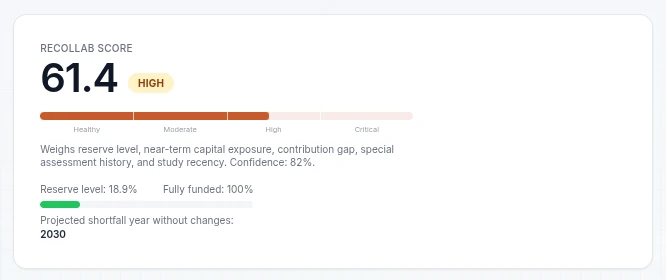
What you get
- The REcollab Score: one number with a risk band from Healthy to Critical. It weighs how well funded the reserve is, the work due in the next 5 years, how soon the fund runs short, how much of the 10-year plan rests on one project, the inflation assumption, the age of the study, and whether routine maintenance spending is sufficient.
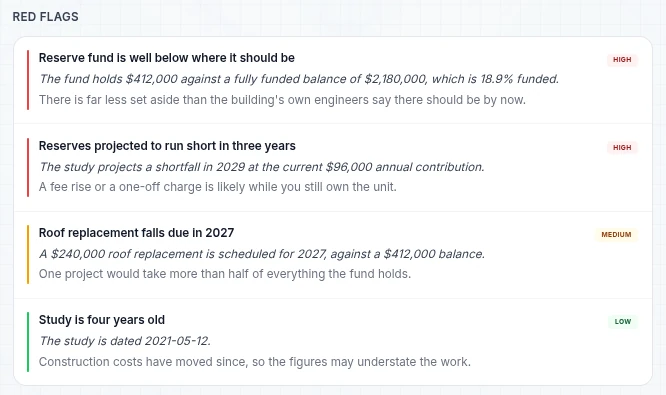
- Red flags, ranked: underfunding, stale costs, fee gaps, and near-term projects the fund can't cover, each marked high, medium, or low.
- A plain-language summary: what the study found, what it asks the building to do, and where it is vague.
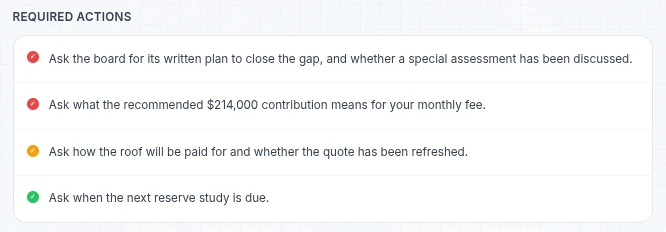
- Required actions: the specific questions to ask the seller, property manager, or board.
- Planned expenditures: the study's 10-year spending plan, laid out in plain terms.
Why not just paste it into ChatGPT?
A general chatbot paraphrases the words on the page. The REcollab Score is different: it is computed from fixed engineering rules, not generated text, so every building is measured against the same yardstick.
The tool is free, with no credit card required.
Your pre-signing checklist
Before you firm up an offer on a resale condo:
- Make the offer conditional on a status certificate review by your lawyer.
- Confirm the date and class of the most recent reserve fund study.
- Check the planned contribution increases for the next 3 to 5 years.
- Look for major projects scheduled in the next 5 years and whether they are funded.
- Ask whether any special assessment is planned or has been discussed.
- Run the study through the REcollab Free Audit Tool and bring the red flags to your agent and lawyer.
A condo is often the biggest purchase of your life. Reading the reserve fund study before you commit can show you whether the building's finances are in order.
Analyze your reserve fund study for free →
Frequently asked questions
Does the status certificate include the full reserve fund study?
No. The certificate states the class and date of the most recent study, who prepared it, and when the next one is due. It also includes a copy of the Notice of Future Funding if the board has sent one; that notice summarizes the study and the funding plan. If you want the full report, ask the seller to request it from the condo corporation before your conditions expire.
How big can reserve fund contribution increases get?
There is no single normal number, because the study sets the schedule for each building. What matters is whether increases are steady and planned, or sudden catch-up jumps. In its 2020 audit, Ontario's Auditor General found underfunded older buildings raising contributions by 3% to 258%, an average of 50%, over 1 to 10 years.
Will a special assessment show up in the status certificate?
One that has already been levied will. The certificate must list any assessments the board has levied against the unit since the current budget, and any known circumstances that may increase the unit's common expenses. An assessment that is only being discussed may not appear yet, so ask directly and review recent board minutes if you can get them.
Who pays a special assessment if I buy during a major project?
It depends on when the assessment is levied and what your agreement of purchase and sale says. Raise it with your lawyer before you waive conditions, and ask whether the price or terms should reflect any assessment that is coming.
Is the audit tool really free?
Yes. Upload the reserve fund study and the summary and score are free, with no credit card required.
Sources: Office of the Auditor General of Ontario, Condominium Oversight in Ontario (December 2020; 69% of 32 examined older buildings underfunded, contribution increases of 3% to 258%); Condominium Act, 1998, sections 93 and 94; O. Reg. 48/01 (study classes and the 3-year cycle); Condominium Authority of Ontario status certificate form; Condominium Authority of Ontario, Guide on Condo Reserve Funds.
This article is general information, not legal or financial advice. Speak with your real estate lawyer before waiving conditions.
Read the building before you buy it.
Upload the reserve fund study and get the red flags in plain language. Free.
Try the Free Audit Tool